In friaries and homes the world over, a ball is on countless screens. We are in the final matches of the 2026 World Cup, and for about a month the whole world has quietly agreed to care, together, about the same small round object. What most people watching don’t know is that the man most often credited with making this spectacle possible was a seventeen-year-old doing homework assigned, unknowingly, by a pope — homework that took him sixty years to finish.

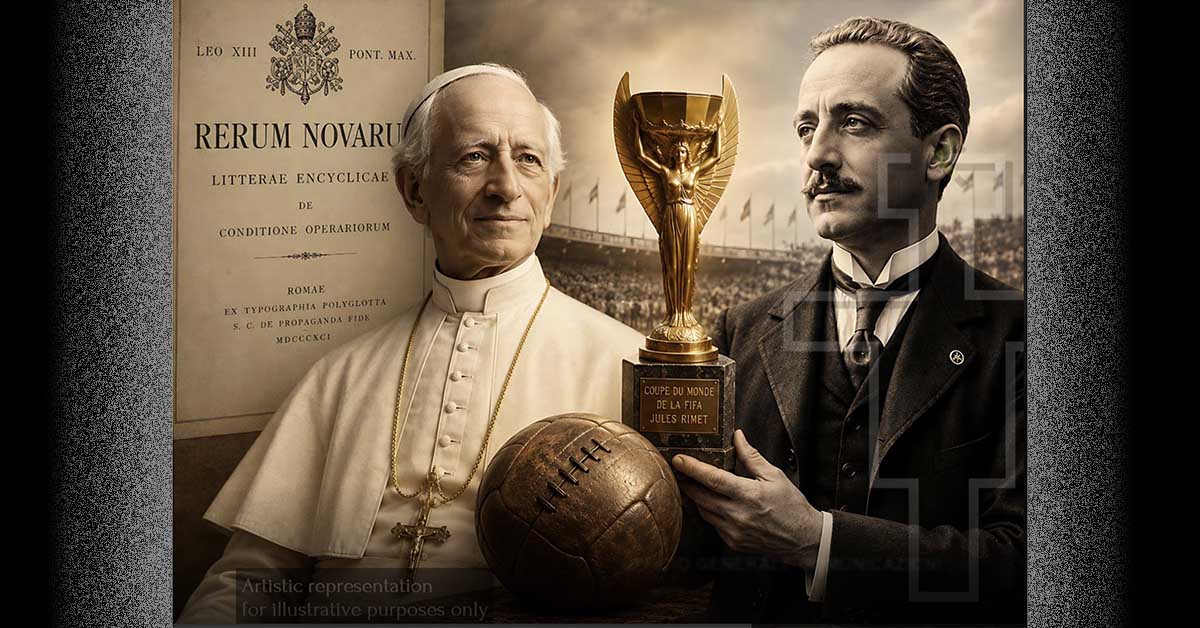
His name was Jules Rimet — a grocer’s son from the small village of Theuley, born in 1873 to a devout French Catholic family. He was seventeen in 1891 when Pope Leo XIII released Rerum Novarum — the encyclical that placed the papacy’s full weight behind the dignity of labor, the rights of workers, and the responsibilities of society toward the poor. Rimet is widely understood to have been deeply influenced by it while still a young man. He started a charity for the poor, then in 1897 founded a Paris sports club, Red Star, that refused to sort its members by class.

This led him, in 1904, to help organize the founding of FIFA — Fédération Internationale de Football Association. He then fought in the First World War and came home believing, almost theologically, that nations who played together might be less inclined to kill each other. In 1930, thirty-nine years after first reading that letter, he boarded a ship for Uruguay with a gold trophy in his luggage to watch the first FIFA World Cup kick off.
That much has made the rounds this month. Here’s a connection I haven’t often seen explored—and my own reading of it.

Leo XIII was himself a professed Secular Franciscan. Rerum Novarum didn’t fall from some abstract height — it came from a pope whose social vision was deeply shaped by a spirituality Francis of Assisi himself embodied when he stripped off his own fine clothes in a public square rather than let cloth and coin define him. A long-standing Franciscan tradition even attributes to Leo XIII the oft-quoted expression, “My social reform is the Third Order of St. Francis.” So, a Catholic teenager spent his life building something that can be read as an attempt to put that vision into practice: a game that wouldn’t care what country you were born in or what your father did, only whether you could play.
I don’t think it’s a stretch to call this a metaphorical sine proprio applied to nations. While the original Jules Rimet Trophy could ultimately become the permanent possession of a nation under the rules then in force, the deeper symbolism remains striking: for ninety minutes, the usual hierarchies of money and power are supposed to fall away, leaving only eleven against eleven on the same-sized rectangle everywhere on earth. That’s Rerum Novarum with a scoreboard — solidarity built into the rules, dignity built into the ball itself: it does not care whose foot touches it.

So, this weekend, Franciscan reader, watch how badly the world still wants that leveling. Remember, too, that someone had to believe it first. Whether or not Rimet consciously understood his life’s work in precisely these terms, he spent the better part of his life building something that sought to unite nations more closely through sport, because a pope deeply shaped by the Franciscan tradition wrote a letter that profoundly shaped his imagination.
Enjoy the Beautiful Game and perhaps say one small prayer of thanks for a grocer’s son from Theuley who took an encyclical seriously enough to help give the world a game that, at its best, still reflects something of its vision.

P.S. As the saying goes, the Church is at her best when she keeps reforming herself — ecclesia semper reformanda. So too, it turns out, for FIFA.
Rimet’s whole gamble can be understood as sport serving as a working model of the common good — solidarity and honest competition ordered toward something bigger than any one player’s or nation’s gain. Whether or not he consciously expressed it in the language of Catholic social teaching, that aspiration echoes concerns expressed in Rerum Novarum. It’s worth admitting how far the institution he built has drifted from that gamble. FIFA’s real reform problem was never what the players earn on the pitch; it’s what the men who run the game have quietly taken off it — the bribery indictments, the bloated executive compensation, the money that follows hosting rights and broadcast deals rather than the sport itself.
Leo XIII’s letter wasn’t really about football, but its principles can reasonably be applied to the boardroom as much as to the factory floor: an institution built on the labor and loyalty of ordinary people owes those people more than a trophy every four years. If Rimet’s generation had to fight for the dignity of the worker, ours may have to fight for the integrity of the game itself — finding, as he once did, new and creative ways to level a field that money keeps tilting.
-friar Michael Lasky OFM Conv.