
Of Divine Proportions

Of Divine Proportions

Franciscans & Finance Part Seven – Sacred Geometry

This series is an excerpt from a presentation by Friar Joseph Wood. 

(Check out Part Five for a recap of the earlier posts
Part Six is an introduction to Friar Luca Pacioli)

Friar Luca Pacioli’s work, Of Divine Proportions,” was the most influential elucidation of the “golden ratio” in his day. It confirmed the long-held belief that God created the world perfectly, and therefore, the highest act of creation, humanity itself, is divinely proportioned.

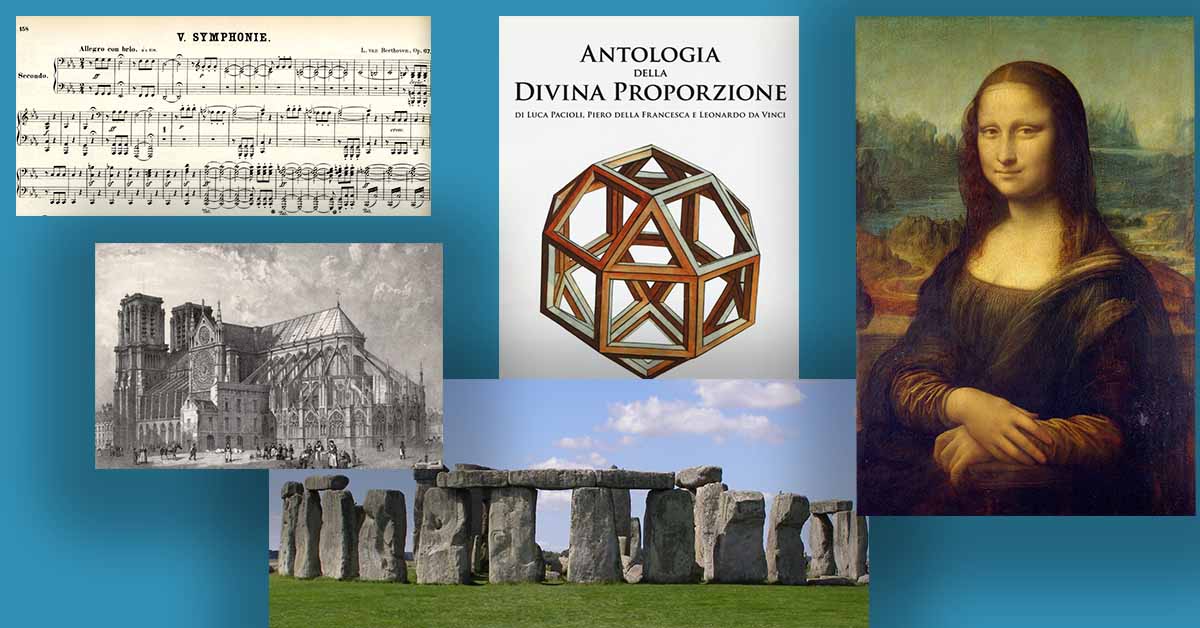
The most outstanding expression of how humans perceive beauty, Divine Proportion is the perfect relationship of forms, spatial arrangements, and harmony of colors and musical cadences. Divine Proportion is in essence geometric and mathematic, and its properties are reflected in the parts of the human body, and such creative works as the layout of Stonehenge, the Parthenon, the cathedral of Notre Dame, the symphonies of Beethoven, the painting of Spring by Botticelli, and the Mona Lisa by Leonardo da Vinci.
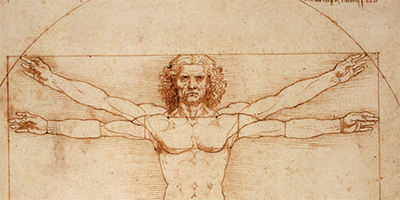
Leonardo da Vinci idealized the concept by drawing his famous “Vitruvian man” (based on the writings of the Roman architect, Vitruvius) as a visual calculation of human proportions geometrically applicable to every element of harmonic design – architecture, music, nature, and the cosmos.


Divina Proportione is a book on mathematics written by Luca Pacioli and illustrated by Leonardo da Vinci. For more about Pacioli and Da Vinci, check out Anthology on Divine Proportion.

The Anthology explains and illustrates how the theme of Divine Proportion fascinated the exceptional minds of the Renaissance: those of Piero della Francesca, who in his Libellus expounded the fundamentals of the theories that would later be developed by Luca Pacioli in De divina proportione and then graphically interpreted by Leonardo da Vinci in his drawings of Pacioli’s polyhedrons.

The Anthology explains and illustrates how the theme of Divine Proportion fascinated the exceptional minds of the Renaissance: those of Piero della Francesca, who in his Libellus expounded the fundamentals of the theories that would later be developed by Luca Pacioli in De divina proportione and then graphically interpreted by Leonardo da Vinci in his drawings of Pacioli’s polyhedrons.

This series is from a presentation by Friar Joseph Wood, Assistant General for the CFF.

In part eight – The Game of Chess