More About Monte di Pietà

More About Monte di Pietà

Part Four – Logo & More About the Monte di Pietà

This series is an excerpt from a presentation by Friar Joseph Wood. 
Part 1 – Introduction
Part 2 – Why Franciscans & Finance?
Part 3 – The Monte di Pieta or deposit of charity

The logo of the Monte di Pietà, which is portrayed on the front of some altars or on the front of some Italian Banks (such as the one below, the Bank of Rome), is Christ as the “Man of Sorrows,” pictured sitting on his sarcophagus, sharing the same pain as those in any type of poverty and suffering. Christ’s suffering, death and resurrection, act as a “deposit of grace,” with his tomb being a treasure chest or bank vault, that we borrowers may withdraw with little interest, the interest being a repayment in charity. However, we, the borrower, would never be able to match the great act of Christ’s own loan toward humanity.

Both Observants and Conventuals promoted the Monte. But besides establishing these institutions in separate buildings with some lay administrators, many were established in the friaries themselves up to the early-1800s, when governments took over all financial institutions.

The Bank of Rome

Compared to other cities, the institution of the Monte was relatively late in Rome. The friars did promote the Monte there, but for a time Pope Paul III had approved another type of institution (in 1539), a “Congregation” of wealthy people who promised to lend money to the poor without expecting interest. The administration of the “Congregation” was initially directed by the Observant friars. Cardinal Charles Borromeo, the Cardinal Protector of the Conventuals, wrote the first regulations and provided his own palace as the first site for the bank. By 1585, Pope Sixtus V, a Conventual, changed the status of the “Congregation” into a Monte and purchased a larger building as a more permanent foundation. Sixtus allowed deposits of any sum to be made at the Monte.
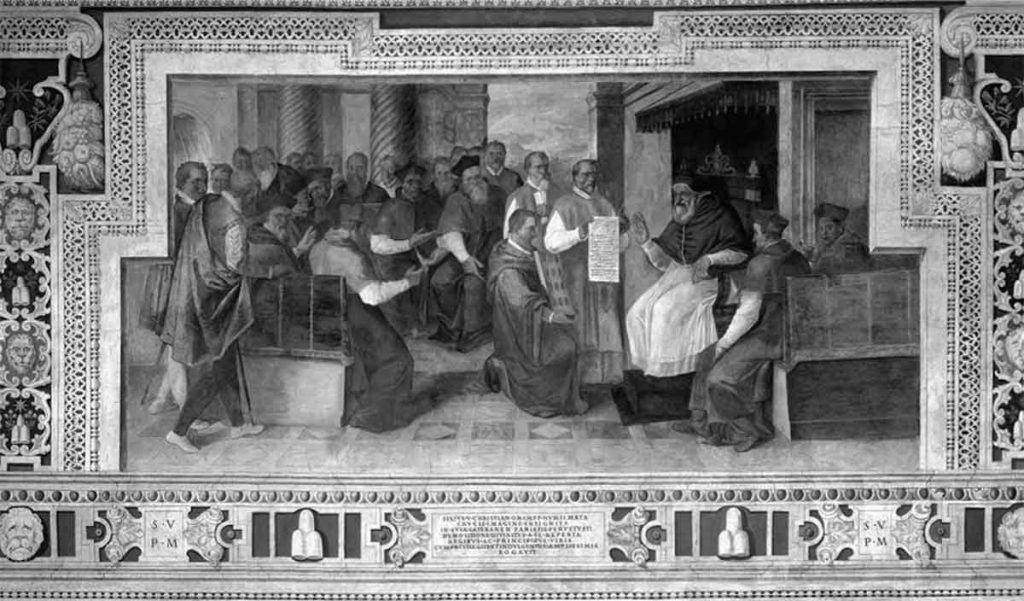
Pope Sixtus V commissioning a Monte di Pietà

In 1637, two hundred years after Italy, France established its first Monte di Pietà in Paris.
This series is from a presentation by Friar Joseph Wood, Assistant General for the CFF.

In part five – the Monte Frumentario