
Chess & Type Design

Chess & Type Design

Franciscans & Finance Part Eight

This series is an excerpt from a presentation by Friar Joseph Wood. 

(Check out Part Five for a recap of the earlier posts;
Part Six is an introduction to Friar Luca Pacioli;
Part Seven – Sacred Geometry)

Most people have heard of Leonardo Da Vinci but Friar Luca Pacioli is not as well known.

Pacioli was considered the finest mathematician that the University of Bologna ever produced. He perfected his proportional skills in the school of the great Renaissance artist, Piero della Francesca. In 1494, Pacioli asked his friend, Leonardo da Vinci, to draw the designs for his intended comprehensive treatise of arithmetic, geometry, and proportion – the first book of its kind to be printed.

Here are two other projects in which the men likely collaborated. 

Type Design

About 1450, Johannes Gutenberg perfected his invention of the printing press so that it could be used commercially. Following his lead, many type designers/engravers, such as the Frenchman Nicolas Jensen (+1480), wanted to improve/redesign the heavy, difficult-to-read calligraphic “black lettering” (medieval manuscript style). Returning from a visit to Italy where he studied the Latin typefaces carved by the Romans, Jensen developed a typeface that was readable, yet retained the look of the human hand wielding a broad nibbed pen.

Nicholas Jensen; A page of Eusebius’ Preparation for the Gospel printed by Nicolas Jenson in 1470. It is thought to be the first appearance of a roman typeface.

Friar Luca Pacioli, collaborating with his artistic and mathematics friend, Leonardo da Vinci, studied the stroke widths and curvature of Jensen’s type, and refined it in his famous series of upper-case letters. Besides being beautiful graphic art, the letters illustrate geometry at work.

The Game of Chess

A manuscript was discovered in 2006 among books purchased in bulk from Count Guglielmo Coronini (Gorizia, Italy) that is presumed to be De ludo scachorum (On the Game of Chess) written by Friar Luca Pacioli around the year 1500.
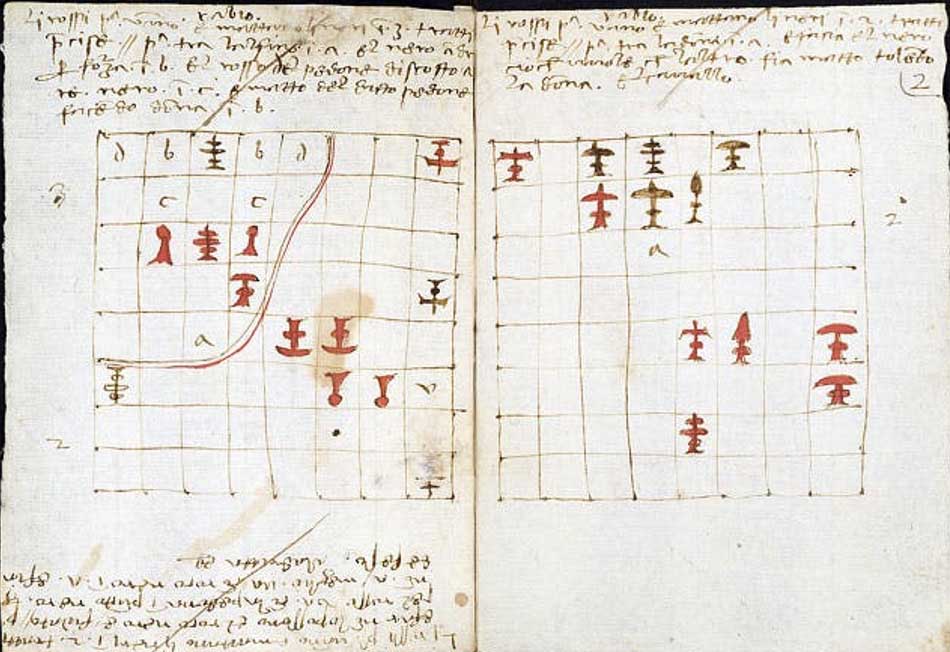
This text was written at a time when the rules for the game of Chess were evolving to the ones we know today (especially regarding the moves of the queen and the bishop). Pacioli’s manuscript contains over 100 Chess problems and their solutions. The manuscript gained greater public attention in February 2008, when another scholar theorized that the Chess diagrams of Pacioli’s manuscript were illustrated by Leonardo da Vinci. Knowing Da Vinci’s involvement with other works of Pacioli, this theory is probably accurate.

This series is from a presentation by Friar Joseph Wood, Assistant General for the CFF.

In Part Nine – The Father of Modern Accounting