
Lessons in Nonviolence from Assisi
From April 22-29, 2026, pilgrims gathered in Assisi, Italy, for the Assisi Peace and Justice Pilgrimage, a retreat exploring the spirituality and practice of nonviolence in the footsteps of St. Francis and St. Clare. The pilgrimage was led by Ken Butigan of the Pace e Bene Nonviolence Service; Michele Dunne, Executive Director of the Franciscan Action Network (FAN); and Friar Michael Lasky, OFM Conv., member of FAN’s Board of Directors.
Over the course of the week, participants moved through the cobbled streets, stone chapels, and quiet hillsides of Assisi, reflecting not only on the lives of Francis and Clare, but also on what it means to practice peace in a world shaped by division, fear, and violence.
The question that seemed to accompany the pilgrimage everywhere was deceptively simple: What is peace?
The answer never arrived as a definition. Instead, it emerged through experience—through silence, storytelling, prayer, walking together, and listening deeply to one another.
At San Damiano, where Clare of Assisi built a radically egalitarian community grounded in prayer, mutuality, and shared discernment, pilgrims reflected on nonviolence as relationship. Clare’s life offered a vision of peace that was not a passive withdrawal from the world, but the creation of a community where dignity was shared and every voice mattered. Her refusal to mirror the violence and hierarchy of her society became its own form of resistance.
In the Basilica of St. Francis, the participants considered Francis’ own transformation from soldier to peacemaker. Before becoming the saint remembered around the world for peace, Francis experienced war, imprisonment, trauma, and profound inner unrest. Standing before the San Damiano Cross years later, he encountered not triumph or power, but the wounded Christ—a revelation that ultimately redirected his life toward reconciliation and nonviolence.
The pilgrimage also included time at Rivotorto and the Chapel of St. Mary Magdalene, both associated with Francis’ encounters with people suffering from leprosy. There, the group reflected on one of the deepest challenges of nonviolence: the willingness to move toward suffering instead of away from it. Francis’ embrace of those people considered untouchable by society became a lesson in recognizing the humanity and sacredness of every person, especially those pushed to the margins.
Another powerful moment came while reflecting on Clare’s response to military attack at San Damiano. According to Franciscan tradition, Clare confronted invading soldiers not with weapons, but with prayer, courage, and presence. Her example invited the participants to consider nonviolence not as weakness, but as the difficult and disciplined practice of remaining grounded in moments of fear without surrendering one’s humanity.
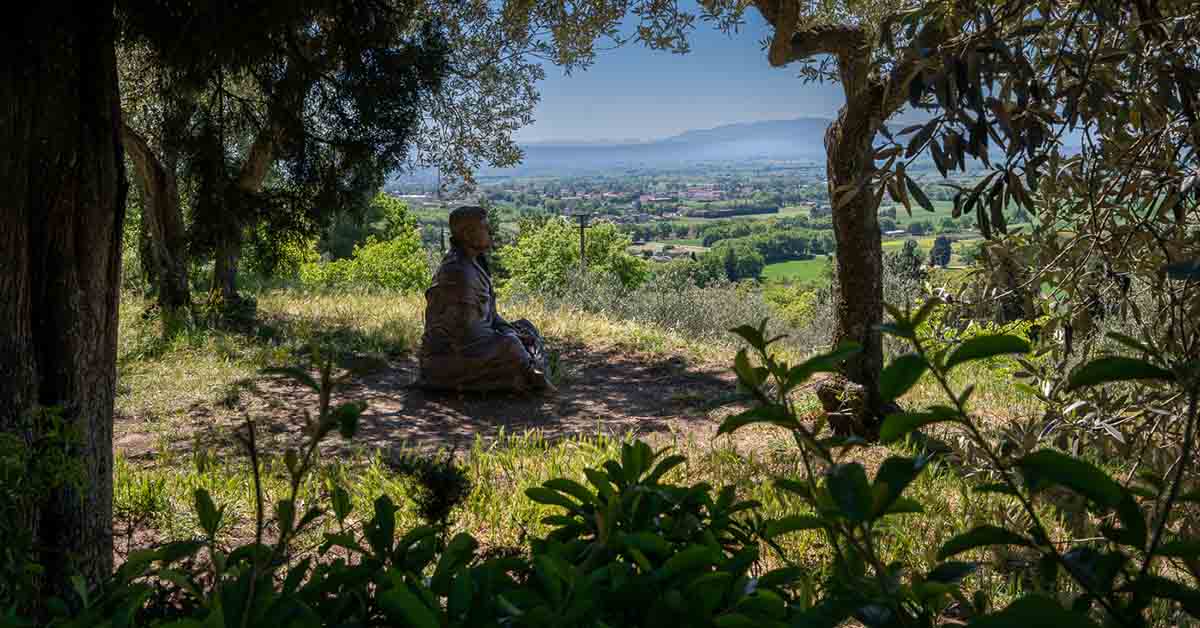
Throughout the week, silence became as important as conversation. Long walks through Assisi’s narrow streets and quiet countryside created space for reflection beyond words. Participants spoke often about how peace revealed itself not as an abstract ideal, but through ordinary acts: patient listening, attentiveness, vulnerability, and the decision to remain present even in discomfort.
By the end of the pilgrimage, many questions remained open. Yet the participants returned home carrying a renewed sense that peace is not so much a destination as it is a daily practice—something cultivated through compassion, humility, courage, and relationship.
In Assisi, peace did not feel distant or idealized. It felt immediate, human, and quietly demanding.
Perhaps that is why people continue making pilgrimage there eight centuries after Francis and Clare first walked its streets. Not simply to remember the saints, but to rediscover the possibility of becoming peacemakers ourselves.
-Friar Michael Lasky OFM Conv.
(See more photos at https://www.ofmconv.net/en/lezioni-di-nonviolenza-da-assisi/)